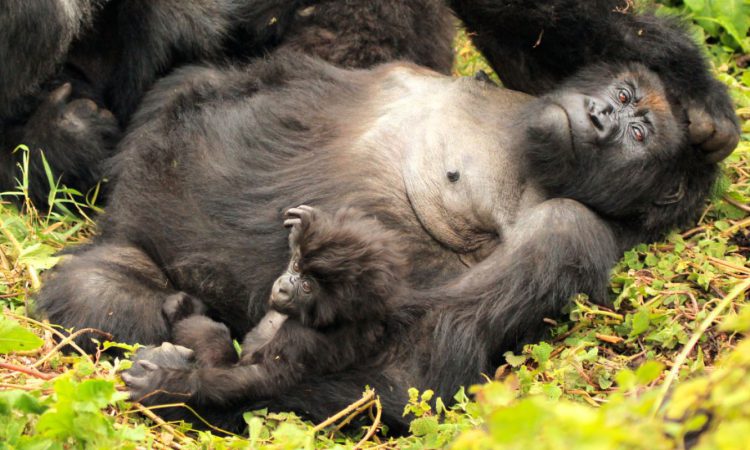
Gorillas live in groups also known as families, each family lead by a silver back which is a dominant male. A group consists of 10 to 40 individuals averagely and they can move a distance of 0.5 to 1.5 kilometers per day depending on the availability of food and location of food. Gorillas are great primate apes that live in tropical rainforests of equatorial Africa in the eastern region.
Therefore, gorillas are categorized in two species; western and eastern gorillas which are further divided into subspecies namely – mountain gorillas, western lowland gorillas, eastern lowland gorillas and cross-river gorillas. These species and subspecies have almost the same behaviors, ways of living and adaptations.
Mountain gorillas are found in three countries in East Africa in Uganda, Rwanda and Democratic Republic of Congo while the eastern lowland gorillas can only be trekked in Democratic Republic of Congo’s Kahuzi-Biega National Park.
Female gorillas give birth after a period of nine months, same as human beings and mothers have to take care of an infant until it becomes a juvenile. A mother sleeps with the baby up to four or five years when it starts practicing making its own nest. Nests are made by females or males and are mostly build up in the trees depending on where the group is situated.
Gorillas move from one place to another in search for food and in case of tiredness during day they make nests and rest. Even though the nest of previous night is near, gorillas can’t sleep there again, they have to build new nests every day. Young ones normally learn from their mothers how they nest as same as adult males.
Gorillas don’t build in any place; they have to first look for the safe areas where to nest which is done dairy. They make their nests by bending tree branches, leaves and other materials around and it’s made in circular form. Since gorillas are much like humans, they can sleep for about 12 hours or even beyond for the whole night.
However, there are two ways how these great primates can decide to sleep during night. One is nest up in the trees and another one is built on ground. Female gorillas usually prefer to sleep up in the trees because of several reasons, but mainly due to their small weight compared to male gorillas and also due to security purposes since they are the silverbacks and mature males that normally sleep on ground.
Quite interestingly, mountain gorillas like nesting on the ground unlike other types of gorillas the prefer to sleep up in the trees towards the canopy for security purposes and other reasons. According to Dian Fossey’s research, gorillas eat early morning and do any other work in the afternoon like nesting and late set off for their last meal till sleeping time.
Gorillas spend most of their time sleeping whereby they sleep during midday, late afternoon and at night making it three shifts that a gorilla can sleep per day. Thus, most gorillas rest on ground both during day and night.
In Uganda, one can trek gorillas in Bwindi impenetrable national Park which harbors almost a half number of mountain gorillas in the whole world and Mgahinga gorilla national Park. In Rwanda which is the country with most expensive gorilla trekking permits, it harbors almost a quarter of mountain gorilla population in Volcanoes National Park, as well as Virunga National Park in D.R. Congo which is also the only country in Africa that offers both mountain gorillas and eastern lowland gorilla trekking.